Uncategorized

#39 Leading in Crisis

In an increasingly connected yet polarized world, the ripple effects of crisis can significantly impact the well-being of employees. When any global conflict occurs, employers face the same question: How should we respond?

There are no easy answers, but this is our call, our work, as leaders – to support our people, especially when things are difficult.

First, make sure everyone is safe and acknowledge the pain.
Focus on the immediate physical, emotional, and mental health of employees and stakeholders. Recognize that social-political upheavals can take a toll on employees’ well-being. Your employees might have diametrically opposing viewpoints (for example, the current Israeli-Palestinian conflict). Reiterate your policies about each person feeling safe in your workplace. Insist that each person’s opinion must be respected. Demonstrate and encourage empathy and tolerance with your attitudes, statements, and actions.

Second, give explicit permission to deal with the crisis.
Communicate that your employees may prioritize caring for their personal needs during a time of crisis; this empowers them to do so. Possibilities include allowing time to unplug from work, flexibility around deadlines, and identifying team members who can help cover workloads. Above all, ensure that your employees know that you care, that they and their health and well-being matter.

Finally, ensure that managers are checking in.
Your top priority is to ensure that each team member feels supported. Managers are usually best positioned to support their direct reports, often by checking in on a regular basis. Actively support your managers because they will be carrying a double load – supporting their direct reports AND dealing with their own emotions.

One final thought:
Do you provide an EAP? Is there an accessible mental telehealth service included in your insurance plan? Are your employees able to take time away from their work to incorporate self-care practices into their day? If not, this might be a good time to create such a policy. Share easy access links to any of the supportive resources your organization provides.

By emphasizing empathy, communication, and flexibility, leaders can help their workforce navigate challenging times while building and maintaining trust within the organization. How you lead your people during these difficult times matters, because it tells them what kind of organization they work for, and whether they can count on you when times get tough.

Adapted from an e-mail from Boly:Welch November 2, 2023.

Gary Langenwalter
#38 The Joke’s on You

Workplaces seem to have become more serious in the last decades based on my personal observations. Workers are intensely focused on their immediate deadlines. Unfortunately, this does not yield the desired long-term results. Yes, deadlines are real, and those deadlines are getting met. But at what cost? Notice the first 4 letters of the word DEADline.

True story from several years ago. A company was in deep sneakers over its major product – perhaps due a safety recall or something equally dire. So the company assembled a group of their best engineers to solve the problem. This group was laser-focused – they HAD to come up with an idea to save the company! They filled the walls with flipcharts of ideas. Unfortunately, there was not a breakthrough idea in the whole bunch. In desperation, the company brought in the “B team” engineers, and these folks were completely irreverent – making jokes, spouting ridiculous ideas such as “let’s make everything purple”, and not taking anything seriously at all. They also filled the walls with flipcharts. When they were finished, there were several excellent, creative ideas, each of which could (and did) save the company.

The moral of the story: humor is one foundation of creativity. It is also one basis for relationships and social interaction. When there is humor in the workplace, people are more creative and enjoy their work more, leading to higher productivity, lower turnover, and higher profitability.

What would your workplace be like if people lightened up? Do you want to try it yourself for a while and see what happens? I’m the fount of puns and Dad jokes, if you need some… 😊

Let me know what you think. I look forward to your feedback.

Gary

#37 Top Priority of Leadership

The top priority of leadership is to create results, increase sales and profits. Right? Maybe, as the final result. BUT results don’t happen in a vacuum. They depend on the underlying culture of the organization. Therefore, I would argue that the most important job of leadership is to create and maintain a healthy, vibrant culture to underpin sustainable performance. In this viewpoint, the essence of leadership is not about “doing,” it’s about “being.

In one company, a department’s culture shifted from “ok” to “somewhat toxic” over about 18 months, with the same people, including the manager, in the department. The manager and HR were totally baffled. Nobody knew what caused it, and the decline happened slowly enough that people didn’t even notice it until it became painfully obvious. This department works 24/7, with 3 shifts (3rd shift is a skeleton). First and second shifts each claim that the other is not doing their job.

Instead of trying to learn why the culture shift happened, which is probably impossible to determine at this point, the manager decided to turn the department around. The manager is going to give out a quick survey sheet to each worker, asking them to rate the health of their workplace on a 1-5 scale, with 1 being toxic and 5 being really great. The survey might also ask how well “their” shift does, and how well the “other” shifts do. Then the manager will hold an all-shifts meeting summarize the surveys, and invite the workers to change their attitude, which is something that only “they” can do – the manager can’t make that happen. The manager will ask if the workers want a great workplace. Assuming that they all agree, the manager will ask them to assume that each person there does the best they can each and every day and look for agreement. The manager will also remind them that no person is perfect (including the manager), so sometimes people screw up and need forgiveness. The manager will ask each person to if they are willing to increase their level of tolerance and forgiveness.

The manager will ask each worker to write down something positive about each co-worker, each week, and then the manager will read those aloud in the weekly cross-shift meeting. A corollary idea is for each person to write down what they are most proud of doing that week, with the manager reading that aloud to the group as well after all the attaboys and attagirls. People will notice major differences between their own perceptions and those of their co-workers; I expect that these differences will slowly converge over time.

One additional idea is that when a person complains about another person’s performance, the complainer and the complainee meet face to face so that the complainee can rebut the complaint. Or else say that they blew it, and they’ll do better next time. Of course, this meeting must be facilitated very carefully; there is a decent possibility of something going wrong, resulting in damaged relationships.

Do you have other ideas? How would you help the manager create a healthy workplace?

Gary Langenwalter

#36 – Start with Why

Want to change the world? Want to have your organization attract and retain the best and brightest, and be a place where you are creative, empowered, and inspired? Then start with “why”.

  1. If you want to motivate others, captivate, don’t manipulate. Most organizations use a carrot and stick approach to motivating their employees. While this works, there is a better way. Good leaders inspire others, inviting them to take action. Enthusiastic employees will bring personal resources to the table and sacrifice themselves to achieve the common goal without being prompted. They don’t act because of rewards or incentives, but because they recognize a deeper meaning in their actions. They feel their calling.

  1. Use the Golden Circle – The Golden Circle is 3 concentric circles with WHY as the bullseye, HOW as the next circle, and WHAT as the outermost circle. WHAT describes the activities of your organization. HOW tells the way in which WHAT is achieved. WHY is the mission or purpose of your organization –why was it founded? What are its main goals? Incidentally, profits are a combination of WHAT and HOW – not a WHY.
  1. Communicate the Golden Circle from the inside out. Focusing on the WHY connects your people at a deeper, more resilient level, and connects your organization with your customers and suppliers. It creates long-lasting loyalty. It creates an atmosphere in which your employees are truly excited. Because of this, organizations that continually focus on WHY are more stable.
  1. Long-term success hinges on survival of the WHY. Focusing on the WHY helps the organization make decisions that promote the long term. Otherwise, they can drift themselves into short-term thinking, resulting in their eventual demise. This is why organizations frequently fail when the founder leaves.
  1. Customer manipulation is counterproductive. Many businesses rely on manipulation to cause customers to buy, including limited time offers, social pressure (such as ads with movie stars), and announcements that don’t tell the whole truth. Yes, these tactics work for the short run. But they don’t create customer loyalty; instead, they create customers who can easily be lured away by the competition. Apple is an excellent example of non-manipulation – they have a fiercely devoted customer base.

These ideas are excerpted from Start with Why by Simon Sinek. Excellent reading!

Hope you’re having a great summer. Stay cool,

Gary Langenwalter

#35 – Creating an Owner’s Mindset

Almost every CEO I know eventually asks, “How do I get my people to act like an owner? To commit to making contributions that are in the best interest of the whole organization and take full responsibility for their choices and outcomes?

My answer is, “Tell me how you lead your organization.”

The leader responds, “I make sure the roles and responsibilities are clear. I establish a clear vision, so everyone knows where we are going and why. Then I am careful to establish clear goals so that everyone knows what they need to do to ensure we get there. After all my people are the most important part of our organization and I want them to be successful.”

I ask, “And when there are difficult situations that come up or a conflict between two of your departments, how does that got resolved?”

“Well, that is what I am here for: to help remove obstacles and sort things out.”

I reply, “Can you begin to see why your people are not acting like owners as you would like them to? If you treat them like young children, they will respond like one. And unconsciously that is what you are doing.”

To be fair, this is not totally the leader’s fault. It’s the way the game of business is set up; it’s embedded deep in our culture. The expectation of a leader is to do exactly what this leader described, which in turn causes people to respond exactly like they do. Most organizations are “like a family”, which implies that the parents (leaders) make all the decisions, and the rest of the organization (the children) aren’t mature enough to be given authority or handle the responsibility of decision-making.

Let me be clear, as a leader it is your responsibility to ensure the organization creates the results required for success. This will never change. And this responsibility naturally leads you to feel the pressure to make sure others do what is required.

What if there was another way? What if we changed the rules of the game and set up a different relationship?

Imagine the leader interacting with their team as if each team member was “CEO” of their own company “contracting” with the parent organization about the contribution “their company” will make to the success of the organization.

Imagine that this group of “companies” understands they are part of an ecosystem, no longer independent entities, and each one depends on the others, and they know their contribution matters only if the whole organization is successful.

This will shift the focus from making people get the results to having them want to achieve those same results – making their contribution something they choose. Since they choose it, they will be committed to it and naturally drive to be successful.

Instead of using your people to get the results, you use the journey of getting results to develop, grow, and mature your people. Encouraging them to resolve the challenges and conflicts themselves will develop their level of maturity and the sense of being the “CEO” of their lives. You coach and guide them to self-reflect and self-improve.

This shifts the role of leader from overseer to coach helping each “CEO” become successful in running “their business,” freeing the leader to focus on more strategic concerns, because they know the ship is in good hands.

Personal experience: When I was a consulting manager at KMPG Peat Marwick, my partner-in-charge challenged me to think of myself as my own consulting company, in a network of other consulting companies. How would I act? What would I do? My mindset shifted; how I interacted with clients and prospects and my fellow consultants shifted. I became an entrepreneur instead of an employee, all because of that one question.

This is based on a blog that was originally published by Vitaly Geyman of Quantum Leaders May 17, 2023. Their website is https://quantumleaders.com/

Want to talk about this? Give me a call (971) 221-8155

#34 – Engaged is NOT enough!

Engaged is not enough! You’ve got to get married! (Sorry; just couldn’t resist 😊)

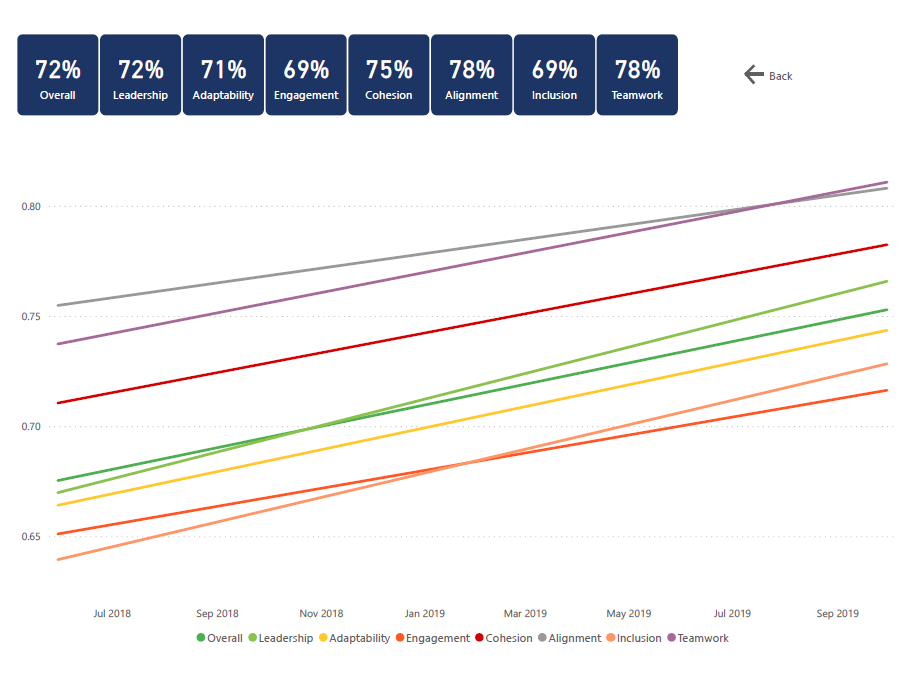
While engagement is absolutely critical, engagement alone is not sufficient for an organization to thrive. The workforce also needs to be aligned and cohesive. Let’s examine those more closely.

Workers can be completely engaged in their workplace. BUT, in addition to being engaged they need to be aligned:

  • Their efforts need to be aligned with the organization’s mission,
  • They need to collaborate across work groups, and
  • They need to focus on meeting the needs of the customers.

Likewise, they need to cohere with their workgroup and the organization. Cohesion has 3 attributes:

  • Adaptability:
    • Continuously improving how they work,
    • Using mistakes as learning opportunities, and
    • Providing upward feedback to leaders.
  • Inclusion:
    • Feeling like they belong, and feeling like a valued member of their workgroup,
    • Being well informed about how the organization is doing, and
    • Being told “why” decisions have been made.
  • Teamwork:
    • Receiving support from others,
    • Trusting their people they work with, and
    • Working together.

Each of these attributes is essential for an organization to accomplish its objectives. One survey that includes these as well as engagement is Vantage Point™. If you’d like to know more, check it out at https://vantagepointsurvey.com.

#32 The Real Patriot’s Day

“Listen, my children, and you shall hear
Of the midnight ride of Paul Revere,
On the eighteenth of April, in Seventy-Five:
Hardly a man is now alive
Who remembers that famous day and year.”

Paul Revere’s Ride – Henry Wadsworth Longfellow

Around Boston, revolutionary re-enactors celebrate Patriot’s Day on the 3rd Monday in April. The morning of April 19th, 1775, 700 redcoats marched to Concord to try to seize cannons and other munitions. Paul Revere and William Dawes rode toward Concord to warn the colonists; they were stopped before they reached Concord, but Samuel Prescott, who joined them partway through their ride, was able to take the news to Concord and beyond. Having been warned earlier, the colonists had removed and hidden the weapons. When the British soldiers reached Lexington, they encountered a group of 77 minutemen standing on the village green with their muskets. A British major ordered “Throw down your arms! Ye villains, ye rebels!” Then somebody, nobody knows actually who, fired a shot. Several British volleys were subsequently fired. When the smoke cleared, eight minutemen were dead and nine wounded, with only one Redcoat wounded.

When the British reached Concord, they only found the wooden carriages for the transporting cannon, which they put into the center of the main street and lit on fire. Then they fanned out looking in vain for stored weapons. More than 500 minutemen (the town of Stow, where I lived, sent more than 80, and other surrounding towns did likewise) watched the blaze from Buttrick’s mansion on the other side of Old North Bridge, which spans the Concord River. They thought that the redcoats were burning the town down. As the redcoats recrossed the bridge after searching in vain for munitions in the fields on the west side of the river, the minutemen started advancing toward the bridge. The redcoats fired, killing two minutemen from the town of Acton. The minutemen responded, killing three British soldiers and wounding nine more. This return volley is the “shot heard round the world.” The outside wall of the Colonial Inn in Concord still bears the holes made by musket balls that day. The minutemen continually harassed the redcoats all the way back to Boston – 18 miles! – hiding behind stone walls and trees. At least 2000 minutemen joined the fray – some estimates are as high as 3500. They killed or wounded 250 redcoats, compared to 90 minutemen killed or wounded.

Notice that we did not file for divorce from King George until July 4, 1776 – 15 months later!

When I lived in Stow, Massachusetts, I was captain of the Stow Minutemen for 5 years. When you visit Boston, be sure to see Old North Bridge in Concord, then walk the hallowed roads and fields, wondering who took cover behind this stone wall or that building.

Here are more resources:

https://www.history.com/topics/american-revolution/battles-of-lexington-and-concord

https://www.battlefields.org/learn/revolutionary-war/battles/lexington-and-concord

https://www.youtube.com/watch?v=DbrbORjrYUE – 11 minutes

https://www.youtube.com/watch?v=jQtkw2tCLyU – 5 minutes

https://www.youtube.com/watch?v=1Pt9CNfdM2g – 15 minutes

Photo courtesy of the Maynard Beacon, Maynard, Massachusetts

#31 R.I.P. or Engaged?

Are your employees R.I.P. (Retired In Place) or engaged? And does it matter?

A recent Gallup survey** shows that organizations with engaged employees outperform their non-engaged counterparts as follows:

  • 23% in profitability
  • 81% in absenteeism
  • 10% in customer loyalty/engagement
  • 18% in productivity (sales)
  • 64% in safety incidents (accidents)
  • 18% in employee turnover for high-turnover organizations
  • 43% in employee turnover for low-turnover organizations
  • 28% in shrinkage (theft)
  • 41% in quality (defects)
  • 58% in patient safety incidents (mortality and falls)

How would your organization perform if your employees were truly engaged? The first step is to measure how engaged your employees are. Oregon Organization Development Network has created an organization health assessment that includes engagement. You can learn more at: www.VantagePointSurvey.com.

* Image by OpenClipart-Vectors from Pixabay

**https://www.gallup.com/workplace/471752/announcing-2023-gallup-exceptional-workplace-award-winners.aspx?utm_source=workplace&utm_medium=email&utm_campaign=gallup_at_work_newsletter_send_1_april_04042023&utm_term=newsletter&utm_content=discover_how_they_did_it_textlink_1

#30 Invest in Your Employees

Why invest in your employees? To help your people grow. And to encourage the best and brightest to stay with you (and attract the best and brightest to join you). They are the ones who are most interested in growing, so whichever organization invests in them will be highly attractive to them. What might this “investment” look like? Here are some ideas – I’m interested in hearing what you’ve done.

  • Professional skills training, including trade schools. To help them become a master electrician (for your maintenance personnel, or for an electrical contractor), certified supply chain professional (for a manufacturer or distributor), or certified therapist (for a social services agency) whatever is appropriate for their field of interest.
  • Continuing education at a local community college or university, including advanced degrees. Suggestion: Reimburse their tuition, fees, and books as long as they earn a grade of B or better. Does this study or degree need to be directly applicable to their current position? Your choice.
  • Life skills, such as budgeting and financial planning, or parenting, or relationships. Some people have been fortunate to learn these skills from parents or others as they grow up; others have not been so fortunate. The classes should be after hours with snacks furnished. You could also open these free classes to family members. How do you know what to offer? Ask your people.
    • For budgeting and financial planning, you can bring in a banker. You can start with an informal survey to learn what specific topics would be of greatest interest. For example, how to manage credit cards, how to reduce debt, how to save for a house, how to improve a credit score (and why that matters), how to make a financial plan (and how to stick with it).
    • For parenting, perhaps someone from a local social service agency or a group of parents and grandparents could lead the sessions. The topics can be targeted at the ages of the children, plus family dynamics.
    • For relationship improvement, you can bring in a therapist. Topics could include how to disagree constructively, how to make decisions when different values are involved, how to regain trust when it has been broken, how to communicate (and how to listen to the other).
    • ESL classes also fit this category.

I really like “life skills” category – the gain is so great, and the cost is so small! Even if only 5-6 people show up, the rest of your organization (and the community) will be aware that you’re offering these classes – and you’ll earn one more plaudit as “an organization that cares about its people”.

#29 No FEAR Performance Review

Most people dread giving and receiving performance reviews. The process is painful and does not produce good results. Jathan Janove has created a 3-step alternative, published by SHRM, the Society for Human Resources Management*.

Step One: Craft a Star Profile (SP) for each position reporting to you. This is not the job description, but it can draw key components from a current job description. Have a real-time conversation with each employee about what you wrote and why. When review time comes (I’m partial to 90-day intervals), the SP will anchor the discussion.

Step Two: In the review discussion, use the No-FEAR technique. Your Frame is a candid, succinct summation of how the employee has done with respect to each prong of the Star Profile. (I recommend taking one prong at a time.) Then switch to active listening (EAR). The discussion will include both feedback (what happened) and what Marshall Goldsmith calls "feedforward" (expected future action). Use this discussion as an opportunity to celebrate successes and accomplishments, as well as to constructively address developmental needs.

Step Three: The last step is the Same Day Summary (SDS) that you’ll write and give to the employee. It captures what you consider to be the key takeaways from the discussion you just had. This is a great tool for every important discussion you have with your employee, including the performance discussion.

An Example

Let’s assume I’m an HR director whose direct reports include HR business partners (BPs) who work directly with company managers and employees. Here’s what my SP might look like:

  • Maintains a thorough working understanding of applicable human resources-related laws, regulations, and policies.
  • Works with our managers and employees primarily as a coach, not a cop.
  • Collaboratively supports fellow members of our HR team.

Prior to the performance review, I will have met with each of my Business Partners to discuss the Star Profile and ensure a shared understanding of what’s most important.

When review time comes, I will employ a technique developed by Goldsmith for Stakeholder Centered Coaching that I call the 3-3-1 assessment. I’ll confidentially ask a representative sample of managers, employees and members of the HR department what they think the Business Partner has done well regarding the Star Profile and what practical improvement suggestions they have for moving forward.

Next, I will meet with each of my Business Partners and review how they’ve done using the No-FEAR methods described above. Lastly, I’ll write a Same Day Summary for each meeting and preserve it for future review and discussion. Here’s an example:

To: BP Sarah

From: Jathan

Today’s date: ___________

Re: Summary of Q1 2023 performance discussion

Hi Sarah,

Here’s a summary of key takeaways from our conversation this morning. Please let me know if I missed anything.

  • Regarding the first sentence of your Star Profile, all parties agree you that you have maintained a solid understanding of applicable law and policy. To keep yourself up-to-date, you plan to attend the online program "Employment Law for HR Professionals." I expressed my encouragement that you continue to seek out these types of opportunities.
  • Regarding the second sentence, we discussed that although your goal is to be seen as a coach, you are sometimes perceived as more of a "cop." You and I agreed to spend more time together doing some role-plays on how to effectively blend compliance with coaching in your interactions with managers and employees. Also, we talked about you benefitting from additional training in coaching and that we’ll work on this moving forward.
  • As for the third sentence, everyone considers you to be a great team player who’s always willing to lend a hand. As I said, I personally appreciate and am grateful for the wonderful service you provide!

Best,

Jathan

* * * * * *

Conclusion

This performance review process has several key advantages:

  • It’s efficient and user-friendly, which lends itself to being done more often than annually.
  • It promotes constructive candor. The focus is on progress and solutions, not finger-pointing.
  • There’s no money involved (bonus or pay increase), as money tends to skew things in the wrong direction. The focus remains on the needs of the job and on the relationship.
  • Above all, the process says, "I may be your boss, yet in reality I’m your partner and coach as we work together to make this organization a better place."

Jathan Janove is a former state bar "Employment Law Attorney of the Year," author of Hard-Won Wisdom: True Stories from the Management Trenches (HarperCollins, 2017), Master Coach & Practice Leader with Marshall Goldsmith Stakeholder Centered Coaching, and faculty member, University of California San Diego Masters Series.

*https://www.shrm.org/resourcesandtools/hr-topics/employee-relations/humanity-into-hr/pages/3-tools-to-replace-the-performance-review.aspx