Leadership

Stopping our Negative Self-Talk

I’ve been struggling the last couple of weeks with negative chatter in my head. I’ve always been a bit perfectionistic and have set-up quite the high bar which makes it fairly easy to not make the mark. When I receive constructive feedback, even though I desire it, it hits me very emotionally. Then I started trying to figure out where that came from.

My fear of abandonment at a very early age caused me to try to fit in at all costs. Be the funniest, the smartest, most accommodating & collaborative. At the same time I was always seeking external approval. What a setup! Trying to please all those people, all the time. Very exhausting. So, my value relied not on my own self-worth, but how others’ saw me. But now at least I’m more aware and working on myself. But it is a long-term journey.

So, what are some of the causes of this negative self-talk chatter? Four ways emotions are created:

1. Chemicals we consume directly affect our brain.

2. Hormones in the body – 30+ hormones that support the brain function.

3. Damages to the brain – due to an accident or impact.

4. Self-talk and pictures we make up in our brain – our internal dial.

Another interesting fact:

1. 65% to 75% of all emotions are created because of the self-talk and the mental images we create inside our minds.

How does this apply to businesses? Why as manager should I be concerned with my employees negative self-talk? Because you as the primary motivator and leader can directly impact some of this. Think about it. Employees, as any normal human being, desire feedback on how they’re doing? Could they do their jobs any better? And you as their manager, provide them with constructive feedback & hopefully, some effective coaching. Often because there’s not enough time in the day…and we don’t take adequate time to think about what we want to convey to our employees. But even taking 5 minutes before you have some feedback for someone will help you get a little clearer.

And most likely, you have your own issues with negative self-talk. So, what better way to address this issue by working on yourself first. So, following are some suggestions to begin the process:

1. Begin by watching and paying attention to you internal dialogue and negative and positive dial.

2. Become aware of your “negative” thinking pattern or patterns.

3. When you start thinking negative thoughts check in with yourself and try to understand why you are thinking this way – take time to be in the moment of what is happening around you that is triggering this negative self-talk or chatter.

4. Take steps to clear the chatter – talk to someone, write it down in a personal journal, stop what you are doing at that moment and start something new, fresh, positive, etc.

Good luck with staying on the positive path!

Greg Sievers

Crock Pot Leadership

I learned 3 important things about leadership from our crock pot.

1. We need the right ingredients. If we’re going to make vegetable soup, we need vegetables. In leadership terms, Jim Collins tells us to “get the right people on the bus.” Accountants have many skills, but a strategic planning meeting with only accountants in the room will usually not generate a well-balanced strategic plan. “Right ingredients” also requires the right amount of each ingredient. When making chocolate chip cookies, too much salt will ruin the cookies. (Of course, extra chocolate chips will only make them better!) Teams need the right mix of the right people.

2. We need to omit ingredients that are not in the recipe. Clams are great in clam chowder, but not welcome in a beef stew. In leadership terms, we need to insure that a team is free of people who will neutralize or destroy it from within.

3. Finally, and possibly most important, we need to define the process and then trust it. If we lift the lid on a crock pot every 10 minutes to see how it’s doing, we ruin the meal by releasing heat such that it will not cook properly. In leadership, we provide the resources the team needs, and then trust them to do their work within the prescribed process. Constantly looking over their shoulders, second-guessing their decisions (or lack thereof), or otherwise micro-managing is like lifting the lid off a crock pot – it guarantees that the result will not be what we want.

I hope you enjoy your holiday meals. And remember, leave the lid on the crock pot until the recipe says the meal is cooked!

Gary Langenwalter

Responding to Ferguson

How will your organization respond to Ferguson?

That depends on the vision and mission of your organization. If your organization exists merely to make profits for the shareholders, Ferguson might be at most a speed bump in your drive to achieve your goal.

If, however, your organization has the goal of creating a better, healthier society while making profits, Ferguson can be an opportunity to create dialogue, asking how people of different backgrounds and cultures can form relationships based on mutual respect and trust. In the final analysis, most humans are inherently similar – we want to be treated with love and respect, we want the opportunity to do something worthwhile, and we want our children and their children to have rich, full lives. You can use these universal goals as the foundation for creating meaningful dialogue, inviting people to work together to achieve them.

If you do this, your organization can be a source of healing, of hope, in an increasingly divisive and divided society. Doing this will directly impact all your people, both white and non-white. Your efforts will also inevitably reach beyond your organization. They will also impact your customers, your suppliers, and the communities within which you operate. You will be taking one seemingly small step toward healing the chasm between whites and minorities. But even though your efforts might seem insignificant, they will be joined by countless other acts of kindness that will indeed create the world we wish to see. As Mother Teresa reminds us, “We cannot do great things, only small things with great love.”

Gary Langenwalter

A True Partner

Most organizations pride themselves on how they help their customers. A select few go far beyond the rest. Umpqua Bank is a leader in those organizations that go far beyond the norm.

So how does Umpqua set itself apart? They focus on building community. Other banks say that; Umpqua does it in many unique ways that are valuable to its customers. Here are 5:

· They staff to have no lines. That means that in non-busy times, “tellers” are waiting customers. Actually, that’s almost always the case – no waiting at all. I’ve had accounts at other banks where lines were the norm.

· Want to take out a loan to buy a car? In other banks, you’d need to see a loan officer. And if that person is busy with another customer, you’ll be waiting a while. Umpqua cross-trains ALL its customer-facing employees. They’re not “tellers” – they’re “Universal Associates.” The difference? Each of them is trained to help you get that car loan – they’ll leave their station and take you into an adjacent meeting room to complete the paperwork in privacy. An Umpqua Universal Associate has the training and skills to be an assistant branch manager for any other bank.

· Umpqua is a place to relax a bit. Each “store” (they’re not “bank branches”) has PCs and a printer available for the public to use. They have easy chairs to sit in, and a selection of current magazines and papers, both financial and non-financial. Much more than just the typical cup of coffee. (Oh, and they have their own roasted coffee beans for customers as well.)

· They give back to the community – in spades! Each employee is encouraged to spend 40 hours/year on community service, such as helping at the local food bank, animal shelter, etc. – on company time, for pay! So when you walk into an Umpqua store, instead of the typical nameplate, you might see a hand-lettered sign saying where that associate volunteers. So far, they have donated more than 250,000 volunteer hours! At 2000 hours/year, that’s 125 volunteer years!

· Finally, some “stores” have meeting rooms available for use by the public, free. For a small business or non-profit, those meeting rooms are much better than the local Starbucks. They are closed, quiet, and private. (And Umpqua even provides free coffee!)

Using Umpqua as an inspiration, can you extrapolate how your organization could go the extra mile for your customers?

Gary Langenwalter

Getting Buy-In

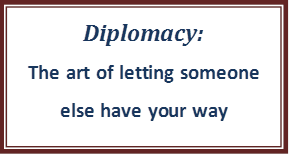
My favorite definition of diplomacy: “the art of letting someone else have your way.” For most of us, that’s a necessary skill in our work and in our personal lives. The real art, however, is in having someone else WANT TO do something – that’s buy-in.

Telling the boss what to do qualifies as a CLM (Career Limiting Move). Ditto for our peers – they can derail our careers if they choose. And although it’s easy to tell the people who report to us what to do, getting their buy-in will improve their performance (and thereby help our careers as well).

The art of achieving buy-in rests in asking the question from the other person’s viewpoint – What’s In It For Me? Why should they want to do what I want them to? Answering that question requires me to put myself in their shoes, to understand what they want, and then to be willing to use my resources to help them achieve their goals.

Buy-in can work with almost anybody, anywhere, and any time. With subordinates, peers, and bosses. It works best, however, when the other party is also interested in creating a win/win.

Buy-in is invitational. It deepens relationship, fosters a spirit of co-creating, demonstrates power sharing. It directly contrasts to the typical power-over, command-and-control behavior that permeates so many of our organizations. It is one small, but powerful, step toward a healthier organization.

Gary Langenwalter

Am I being authentic or am I just wearing a mask?

I ponder… what does it truly mean to be authentic? But I then immediately went to all the years I had not been authentic, true to myself. I find it funny that many of us are wired to go to the negative aspect of our values first. Just possibly that’s what happens to us as we go to school and then enter the world of business. We are criticized, corrected and contained. The 3 year old (our inner child) who’s being completely authentic and uninhibited, turns into a pleaser as we grow older attempting to get the good grades, do well in sports and music and have a lot of friends. Then off to the world of business, trying to fit into the corporate culture, please my boss and teammates and busting my ass to complete my assignments in a timely fashion. I became a role. I was actually wearing a “mask”. Hiding my true identity. I became a pleaser of others. I had lost sight of my inner child, my authentic self.

I sincerely believe that the truth will set you free. But when I was trying to fit in at all costs, I was not being truthful. I was not being honest with myself. But what was I afraid of anyway? As I began doing human potential workshops (in my 40’s) on my path to self-discovery I realized I had a major fear of abandonment. That fear was pervasive throughout most of my child & much of my adulthood. It became a part of my operating system. I had to fit in at all costs. But what were those costs? One was my inner child. That was a real cost! As I continued to work on my fear of abandonment I realized I truly needed to nurture that inner child, my spirit, my soul! It may come out as this spontaneous humorous person, participating in a drumming circle, dancing like no one’s watching or just deciding to take a nap. Kinda sounds like a 3 year old doesn’t it?! So, the work continues today. There is no finish line. I continue to uncover my deepest desires and dreams. So, that has become my lifelong quest, my journey…to become clearer on who I am and how I want to be (& will) show up on this world!

“One can choose to go back toward safety or forward toward growth. Growth must be chosen again and again; fear must be overcome again and again.”

Abraham Maslow

Authentically Yours,

Greg Sievers

Work for Free?

If you stopped paying your employees, how many would continue to work for you?

Yes, I know that they appreciate being paid, and most do not have the luxury of working for no pay. But let’s ignore that for a moment, and ask the question again: If you were not able to pay your employees, what would you do in order to attract and retain volunteers to keep your organization going?

Peter Drucker has said that not-for-profit organizations are the leading edge of leadership, because leaders in those organizations have to lead people much more effectively, since a large part of their workforce is volunteer. Volunteers work for an organization because they are attracted to the vision and mission and purpose, and because they are treated with respect.

To be truly revolutionary, you could ask your employees why they work for you. Hint: most people do not work primarily for the money. Most people could find another job making roughly the same income. Why do they stay with you?

And then ask them what they would like to see changed to make their work experience more meaningful.

However, be aware that the mere act of asking these questions raises expectations on the part of the employees, so before you ask them, you’ll need to be committed to do something with their answers.

GloryBee, in Eugene, has a formal process of asking each employee a series of questions like this (outside of the performance review). The dialogue between employee and supervisor has 9 questions, each of which is answered by the employee and the supervisor. The first question is, “What made you choose GloryBee as your employer?” The form is posted in the Ideas section of our website. http://wp.me/P4ohNu-7t3

If you stopped paying your employees, how many would continue to work for you?

Gary Langenwalter

Be Right or Be In Relationship – Your Choice

Every waking moment, you get to choose: you can be right or be in relationship. This is true everywhere: at work, at home, with your friends.

Life is that simple, and that difficult. Deciding that relationship is more important that being right means you consciously choose to “be wrong”, to be willing to let go of your hard-won truths. In almost all organizations, people are expected to be right – to make the sales forecast come true, to keep expenses to the budgeted amount, to spend only X minutes (or Y seconds) on a customer call… The Goal, Goldratt’s business novel that has sold more than 6 million copies, been translated into 21 languages, and taught in more than 200 colleges and universities, states, “The goal of a business is to make money.” The end of making money justifies the means of doing whatever it takes, as long as it is legal.

However, a little-heralded book (Seven Pillars of Servant Leadership, Sipe and Frick, 2009) demonstrates clearly that for-profit businesses that are based on relationship outperform numbers-based businesses by more than 2 to 1 (24% to 11% annual ROI). And Jim Collins’ “Good to Great” companies earned only 17.5% during the same period. The 11 servant-led companies include Southwest Airlines, Starbucks, Marriott International, and FedEx.

Being right feeds the need to be in control. It manifests itself in power-over, in hierarchy, in fear. It assumes a zero-sum, win/lose, competitive world. It is based in competitive individualism, “it’s all about me.”

Being in relationship supports creativity and messiness and holism. It manifests itself in peer-to-peer, self-organized teams and groups, and in love (even in the workplace!) It creates a win/win, cooperative world, in which all persons benefit. It creates supportive community.

You can be right, or you can be in relationship. You get to choose, every waking moment.

I welcome your comments. gary@portlandconsultinggroup.com

Gary Langenwalter

We’re Built to Learn

My granddaughter loves to learn – how to climb up stairs, how to pet a cat, etc. I like to learn as well (except for the more abstruse features of my smart phone). Humans are naturally curious – that makes us learning machines. So what can you learn today?

I invested in learning for 2 hours yesterday at a Fundamentals of Organization Development course, jointly created by Cascade Employers’ Association and Oregon Organization Development Network. This was the 2nd of 6 sessions. I’d invite you to join us, but the room is full. (I hope you’ll sign up next year.) Yesterday’s topic was strategic planning. Now, I’ve led strategic planning with clients and taught it at the graduate level, so one might suggest I don’t need to sit in on a 2 hour workshop on strategic planning. If I knew everything there is to know, I would agree with that statement. But I attended for 2 reasons:

1. To refresh myself on the concepts that I already know (even great sports stars use coaches to continue to improve), and

2. To learn concepts that I didn’t know.

I did learn a couple nuggets. I also reinforced a couple key concepts, including “letting go”, which will be the topic of another blog.

I have recently learned that learning is easiest for the very young, because they don’t have any preconceived ideas about what is. They are a blank slate. As we learn, we create our mental map of how society and our organizations and our families operate. This is invaluable – we could not function without it! However, once we have that map in place, learning something new requires letting go of something we have already learned, something we think is “true”. Thus, the longer we continue through life, the more difficult learning becomes, because we have more to unlearn.

So what can you learn today? And what are you willing to unlearn, so you can learn something new?

Gary Langenwalter

gary@portlandconsultinggroup.com

Complex Adaptive Systems – a New Paradigm

Most business systems and processes follow Newtonian principles – fixed input, process, output. And that works well for predictable, simple situations.

However, for larger systems, life and random chaos continue to intrude, so that humans have to continue to override or go outside of their formal deterministic systems. Some examples include supply chains, health care, weather, biological systems, and education. Trying to create and impose “If-then” one-size-fits-all logical systems in these environments is like driving a surveyor’s stake into the ocean. As much as we would prefer to live in a simple, predictable world, our world is actually extremely complex. So perhaps we would benefit from using a new theory, that of complex adaptive systems.

The principles of complex adaptive systems include:

· Emergence / evolution – a complex adaptive system emerges from its current state to change to a new state. It continually evolves, with no “grand plan”.

· Sub-optimal – a complex adaptive system is never “perfect”, because its components continue to change to fit the new environment, and its components are never all “perfect” at the same time. In fact, striving for perfection in a component can seriously degrade the performance of the entire system. (Contrary to typical Newtonian principles, in which we assume that if we can make the components “perfect”, the entire system will be “perfect”.

· Connectivity – the connections themselves are a critical part of the system. The system lives and functions in the relationships, the connections, rather than as just a sum of the parts.

· Self-organizing – there is no command and control hierarchy – instead, the system constantly organizes and reorganizes itself. One excellent example is self-managed work teams.

· Simple rules – complex adaptive systems actually follow a few very simple, fundamental rules. For example, the water system in our planet follows the law of gravity (water flows downhill) and evaporation.

· Nested – most systems are nested within other systems, again with no command and control hierarchy. The relationships ebb and flow.

· Edge of Chaos – complex adaptive systems live on the edge between equilibrium and chaos, like the saltwater marsh at the edge of the ocean. A system in equilibrium is frequently hard-pressed to adapt to changes in its environment, and will therefore die. Therefore, the most productive state for a system is being a complex adaptive system.

Where does that leave us? If we’re trying to make our organization, or our customers, or our family, fit into a logical box and follow the rules we want to impose, I can guarantee that we’ll be both ineffective and frustrated. We can, instead, start looking at these complex systems for what they really are and how they really operate.

How does this concept fit your own personal experience? You can reach me by e-mail at gary or by phone at 971-221-8155.

Gary Langenwalter

This blog is based on the work of Peter Fryer. http://www.trojanmice.com/articles/complexadaptivesystems.htm