Uncategorized

#28: Workplace Ritual Revival – a Gen Z Primer

For Gen Zers who started new jobs remotely over the past couple of years, the concept of an in-person happy hour may be as foreign as using a rotary dial phone. But as employers nudge people back into the office, there’s something to be said for the revival of the workplace ritual.

Millennials, Gen Xers, and boomers have loads of experience with after-work activities. Before the pandemic, the boss or the office social butterfly would organize happy hours, trivia nights, or—if you were really unlucky—karaoke. The idea was to create relationships with colleagues outside the office that would translate to stronger professional ties.All of that changed when the pandemic hit and work for many people went online, causing the humble (if not totally spontaneous) midday coffee run with your coworker to devolve into a scheduled, 30-minute virtual catch-up. Even when people returned to the office, they found that some of their cherished coworkers had moved out of the cities where they had once worked; others who grew accustomed to the flexibility that working from home afforded them have yet to return. For as much as life has rebounded since the beginning of the pandemic, many Gen Zers (and likely a millennial or two) who work remotely report feeling lonely, making the workplace ritual a newly compelling idea.
The best of these rituals helps define workplace culture. As McKinsey senior partner Bill Schaningerobserves in a recent episode of the McKinsey Talks Talent podcast, “Rituals are what make us us.” When they’re done well (that is, when they are inclusive and meaningful), they can help employees feel a sense of purpose or kinship with their colleagues, both of which can help reduce instances of depression and anxiety, as well as quiet quitting (see our blog #25 January 16).
So how do you convince Gen Z—or anyone who now prefers to work remotely—to engage in these office rituals? For one thing, some of these rituals don’t have to happen in the workplace at all. Sending a weekly email or direct message that focuses on mindfulness or gratitude, for example, can help create the kind of goodwill fostered from in-person get-togethers.

And for those of us who do want to get back to in-person activities, rituals can be centered on milestones like welcoming a new team member, acknowledging a promotion, or holding a send-off for someone leaving the team.

A final word of warning: let “forced fun” be a lesson to anyone reading this—think twice before making these rituals mandatory. Instead, take the pulse of what your team actually wants to do together. If you’re a Gen Zer, feel free to offer your own ideas and even take charge of planning something, making any rituals explicitly optional.

McKinsey Mind the Gap Monday February 6, 2023

Employee Engagement Needs a Rebound

Recent Gallup survey findings: after trending up in recent years, employee engagement in the U.S. saw its first annual decline in a decade — dropping from 36% engaged employees in 2020 to 34% in 2021. This pattern continued into 2022, as 32% of full- and part-time employees working for organizations are now engaged, while 18% are actively disengaged. Active disengagement increased by two percentage points from 2021 and four points from 2020.

The ratio of engaged to actively disengaged workers in the U.S. is 1.8-to-1, down from 2.1-to-1 in 2021 and 2.6-to-1 in 2020. This is the lowest ratio of engaged to actively disengaged employees in the U.S. since 2013, almost a decade earlier. The record high is a ratio of 2.7-to-1 recorded in 2019.

The decline began in late 2021. The 32% of engaged employees in 2022 is equivalent to the percentage in the second half of 2021. The engagement elements that declined the most from the pre-pandemic record-high engagement ratio in 2019 to 2022 were:

  • clarity of expectations
  • connection to the mission or purpose of the company
  • opportunities to learn and grow
  • opportunities to do what employees do best
  • feeling cared about at work

Gallup found a six-point decline in the percentage of employees who are extremely satisfied with their organization as a place to work. These are all indications that employees are feeling more disconnected from their employers. Clarity of expectations was lower across many demographic groups including age, gender, managerial status, remote working status, and job types. Other engagement elements were affected differently across demographic groups.

  • Age: Younger workers’ engagement was impacted more than older workers. Engagement for those under age 35 (young millennials and Gen Zers) decreased by four points and active disengagement in this same group increased by four points compared with before the pandemic. Engagement among older workers (those 35 years and older) decreased by two points and the percentage actively disengaged in this group increased by one point.
  • Gender: Women experienced more of a decline in engagement than men. Engagement among women declined by four points and active disengagement increased by three points. Engagement among men declined by only one point and active disengagement increased by the same amount.
  • Job Type: Engagement declined the most among individual contributors and project managers — the same group that saw the largest increase in the percentage who are actively disengaged. Engagement among project managers declined by six points and active disengagement increased by four points.

Among job types, engagement declined the most among healthcare workers (seven points) from 2019 to 2022. White-collar workers saw a four-point decline in the percentage engaged. For both healthcare and white-collar workers, nearly all of the shift from engaged employees was into the “quiet quitter” (aka not engaged) category as opposed to actively disengaged.

  • Remote and On-Site Jobs: For those in hybrid and fully on-site work locations, employee engagement declined from 2019 to 2022. Regardless of work location (including fully remote employees), organizational satisfaction, clarity of expectations, opportunities to do what you do best, and feeling connected to the organization’s mission or purpose declined substantially.

The largest decline in employee engagement was among those in remote-ready jobs who are currently working fully on-site — this group saw a decline of five points in engagement and an increase of seven points in active disengagement. It’s worth noting that exclusively remote employees saw an increase of four points in “quiet quitting” (aka not engaged in their work and workplace).

Where do we start? Focus on clarifying expectations. The most concerning decline has been in the lack of clear expectations for employees across all demographic groups when comparing engagement pre-pandemic with the latest findings. This element is the most foundational of all engagement elements. A lack of role clarity makes all other engagement elements less impactful — employees cannot perform at a high level when they are confused as to what they are supposed to do.

Confused employees are more likely to look for other work and eventually leave the organization. What could be causing this consistent lack of clarity?

  • Leadership not clearly communicating the organization’s intended cultural values and strategy in the new world of work.
  • Young workers who are in remote or hybrid settings are the most vulnerable — the increased frequency of physical separation may contribute to this.
  • Managers not being in touch with the ongoing work-life challenges.

Next Steps:

  1. Conduct an organizational health assessment. This can be done quickly and provides a road map to your highest productivity ever. One such assessment is Vantage Point™. More details on www.vantagepointsurvey.com.
  2. Embrace hybrid work for remote-ready employees. Do this or you will have an uphill battle in attracting and retaining star employees.
  3. Establish on-site days as Tuesday/Wednesday/Thursday. These days match with most employee preferences, but don’t make it a policy. Announce it as your new way of working. It is a promise employees make to each other, not a promise they make to management. Employees need to know which days people are in the office together for the highest collaboration and innovation. Customers and suppliers need to know when people are in the office, too.
  4. The manager must now hold one meaningful conversation per week with each employee

#26 Compassionate Termination

We encourage a compassionate approach to termination.

We know that many of our clients hire employees, work with them for years, and still want the best for them after the relationship has run its course. Compassionate termination attempts to preserve dignity, self-esteem, and connection — even in the midst of a challenging process.

There isn’t one right way to compassionately terminate someone, but we have some recommendations.

6 best practices to keep in mind:

1) First and foremost, the termination should not be a surprise. To the extent possible, the employee and their manager should have had multiple conversations about the situation or individual issues, in as close to real time as possible.

2) Before termination, take care of logistics. Have a final paycheck ready and a plan for collecting equipment, removing access, returning personal possessions, etc. Be ready to communicate about severance (if applicable), continuing health insurance options, and any resources you’d like to provide (information on applying for unemployment, professional outplacement help, etc.).

3) Make it a graceful exit. Before the termination conversation, create a plan for communicating about the termination, both internally and externally. Know which exit logistics you’re comfortable ceding control on. Clarify how you can support their career in the future (are you open to providing references or introductions to other firms?).

4) During the termination conversation, be both straightforward and direct at the outset: “I have some bad news — we’re terminating your employment.” You can discuss reasons why but may want to speak with an attorney first.

5) Provide space for the employee to speak and be heard — but focus the conversation on acknowledging and appreciating their contributions, their strengths moving forward, and next steps in the process. Ideally, this conversation is short. Much more than 20 minutes or so and you’ve lost control of the conversation.

6) Prepare a follow-up communication regarding details. Know that a person being terminated is often not in a mental state to hear or remember these details during the initial conversation.

Know that it might not go well, and that’s okay. You’ve done your best provide a dignified end to a working relationship.

Thanks to Abby Enders at Boly:Welch for this blog.

https://bolywelch.com/blog/compassionate-termination/?utm_source=Client+Contacts&utm_campaign=d5f5cc9266-EMAIL_CAMPAIGN_2023_01_26_09_14&utm_medium=email&utm_term=0_9179b0475e-d5f5cc9266-593435931

Gary Langenwalter

Quiet Quitting

Quiet quitting is not really about quitting. It’s a philosophy about not going above and beyond. And, with a historically tight labor market leading to increased job security in many industries, many employees are now feeling empowered to reevaluate the way they work.

A 20-something engineer named Zaid Khan aired a 17-second video on TikTok, during which he says, “I recently learned about this term called quiet quitting, where you’re not outright quitting your job, but you’re quitting the idea of going above and beyond. You’re still performing your duties, but you’re no longer subscribing to the hustle culture mentality that work has to be your life. The reality is it’s not — and your worth as a person is not defined by your labor."

This trend has recently emerged in the news with a shift in perspective: as the economic outlook worsens and outright quitting becomes less feasible for many, this quiet alternative is likely to become increasingly common. A recent Gallup survey found that quiet quitters comprise at least half of the US workforce!

Recently, Elon Musk gave Twitter workers a choice between working until the job was done (e.g. lots of overtime) and quitting. Many Twitter employees chose quitting. Our younger son, an engineer, made the same choice several years ago at a local company.

What would happen if we examined our expectations of workers? Let’s look at the math. If a person works 9 hours a day instead of 8, where does the additional work hour come from? The rest of a person’s workday has several major blocks, such as commuting; sleeping; “personal stuff” such as shopping, doctor’s visits, etc.; and family time. The only two categories that are somewhat flexible are sleeping and family time, so that’s where the one hour per day gets taken from. And sleep reduction is, at best, a short-term strategy. That leaves family/personal time as the block from which the overtime gets drawn. And for many (most?) employees, family/personal time is a precious commodity.

So instead of designing our organizations to expect and assume unpaid overtime, what would happen if we design them to have everyone be as effective as possible during their 8-hour workday? How about that for a radical idea? It’s possible, you know. We can use Lean thinking to eliminate wasted time and effort. Additionally, studies have shown that over the long run people get as much done in an 8-hour workday as they do in a 9-hour workday, because they don’t work quite as intensely during a 9-hour workday (pacing themselves so that they can be at work for the full 9 hours).

What do you think? Would this work in your organization?

Gary Langenwalter

Sources:

Sometimes Life Intrudes!

Sometimes life intrudes on our plans. This can provide the opportunity to step back and examine our priorities, to discard those commitments and activities that no longer serve us and to embrace new ones in their place.

My plans got seriously “intruded” 2 days before Thanksgiving when my wife was doing her aerobics in her home office. She slipped off the edge of a step-up block, fell backwards and broke her arm at the wrist and caused a hairline compression fracture in her back. In just a couple seconds she went from being fully independent to pretty dependent on me. So I learned how to cook, do laundry, help her bathe and dress, etc. My heart goes out to single parents of preschoolers. They have to do this every day, and the preschoolers are not nearly as cooperative and understanding as my wife.

Three days later, the solid-state hard drive on my 18-month-old computer decided to flake. Unfortunately, my backup had quit working a couple months earlier due to a software incompatibility issue – I was on the phone to tech support of the backup company when the drive died. For six days I had no computer. And my computer calendar organizes my life. I finally got my laptop back with a new hard drive and all the files miraculously recovered from the old hard drive, EXCEPT my Outlook e-mails and contacts and all the websites and logins that I use. This e-mail is one example – I had to get into my WordPress account to find the Post by e-mail e-mail address – 30 minutes of fun and games.

Just as we were reaching a reasonable steady state, both of us caught the seasonal flu the week before Christmas. We’re both disgustingly healthy and never stay down for long – typical time to get completely well is 2-3 days. This flu is different – 3 weeks later, we’re still coughing and slowly improving. We’re finally able to start resuming our activities both on Zoom and in person.

When life intrudes on our plans, priorities can become much clearer. When I reviewed where I was spending my time, I decided to de-emphasize or eliminate some activities to make room for other activities to help me move forward professionally and personally. One major change – spending more time with friends and family. We have truly appreciated them for being there for us, including bringing us meals and just checking in. And I am so grateful for the many people who stepped in to keep things running in various organizations in my protracted absence.

Stay well,

Gary Langenwalter

23 Looking for workers? Reach for the STARs

Looking for workers? One potential source is STARs – persons who are Skilled Through Alternative Routes. Those routes can include:

  • Life experience,
  • On the job training,
  • Military,
  • Peace Corps / Americorps,
  • Community college, and
  • Hobbies.

When I was the IT Director for a manufacturing company, I transferred a shop floor foreman to become a programmer – he had taken a night course in programming and loved it. He was passionate about programming, not the shop floor. Yes, he had a decent-sized learning curve, and he was worth it.

Of the list above, life experience is the most prevalent. It also requires the most creative thinking to see how the skills can translate to a specific position. Consider a stay-at-home parent of 2 preschoolers. The parent has many skills which are directly applicable to the workplace:

  • Working under pressure,
  • Responding to competing demands,
  • Planning and scheduling,
  • Adapting to ever-changing circumstances,
  • Multi-tasking,
  • Patience, and
  • Expressing their ideas in terms the “customer” (their preschoolers) can understand)

What would it take for your organization to hire a stay-at-home parent? Some obvious alternatives:

  1. Provide on-site child care,
  2. Allow flex hours, and/or
  3. Structure your work for part-time employees. This might include job-sharing.

If some of your positions require a degree, is that degree really necessary? Or is that requirement preventing otherwise-qualified persons from joining your organization?

An added benefit: using STARs can potentially help you increase the diversity of your workforce. According to the New York Times, 62% of Black people, 55% of Hispanic people, and 50% of non-Hispanic white people have become skilled through alternative routes.

https://www.nytimes.com/2021/10/18/opinion/college-degrees-employers.html?searchResultPosition=1

Gary Langenwalter

Hybrid Work – Future Trends

  • 56% (70+ million) of U.S. workers can do their job working remotely
  • When an employee’s location preference doesn’t match their current work location, burnout rises while engagement drops
  1. How many remote-capable employees are currently working hybrid or fully remote?

Approximately 56% of full-time employees in the U.S. — more than 70 million workers — say their job can be done working remotely from home. We call them "remote-capable employees."

Current work location for remote-capable workers as of June 2022:

· 50% are working hybrid (part of their week at home and part on-site)

· 30% are exclusively working remotely

· 20% are entirely on-site

  1. Where do remote-capable employees expect to work long term and where would they prefer to work?

Hybrid work has increased in 2022 (from 42% in February to 49% in June) and is expected to further increase to 55% of remote-capable workers by the end of 2022 and beyond. This shift aligns closely with the preferences of many remote-capable workers, as 60% want a long-term hybrid work arrangement.

Fully remote work arrangements are expected to continue decreasing from three in 10 remote-capable employees in June, down to two in 10 for the long term, despite 34% wanting to permanently work from home. Nonetheless, long-term, fully remote work arrangements are expected to nearly triple compared to 2019 figures.

Fully on-site work is expected to remain a relic of the past with only two in 10 remote-capable employees currently working entirely on-site and about the same number expecting to be entirely on-site in the future — down from a whopping 60% in 2019. A mere 6% want to work entirely on-site going forward. Given that more than 90% of 70 million employees say they don’t want to come back to the office full time, it’s time to redesign your workplace expectations and your management policies and processes.

  1. What happens when remote-capable employees do not work in their preferred location(s)?

The risk: Employees who don’t work in their preferred location have significantly lower employee engagement, alongside higher burnout and desire to quit. They simply do not feel well-positioned to do their best work or live their best life.

Changing expectations from workers who feel stuck on-site: On-site workers whose job is remote capable have an increasing desire for remote flexibility. While the majority (65%) prefer hybrid work; the desire to exclusively Work From Home has doubled since October of 2021.

The endowment effect: Behavioral economics teaches us that people do not like to give up things they have acquired — we’re loss-averse by nature. Thus, many employees working hybrid or fully remote have come to expect permanent remote flexibility.

· six in 10 exclusively remote employees are "extremely likely to change companies" if not offered remote flexibility

· three in 10 hybrid employees are "extremely likely to change companies" if not offered remote flexibility

· the demand for long-term remote flexibility has substantially increased since June 2021

Excerpted from Returning to the Office: The Current, Preferred and Future State of Remote Work August 31, 2022, by Ben Wigert and Sangeeta Agrawal, Gallup. This article is based on a nationally representative sample of 8,090 remote-capable U.S. employees surveyed in June 2022

AUTHOR(S)

Ben Wigert is Director of Research and Strategy, Workplace Management, at Gallup.

Sangeeta Agrawal is a Research Manager for Gallup.

Full Article is available at: https://www.gallup.com/workplace/397751/returning-office-current-preferred-future-state-remote-work.aspx?utm_source=workplace&utm_medium=email&utm_campaign=gallup_at_work_newsletter_send_1_october_10042022&utm_term=newsletter&utm_content=discover_what_the_data_are_saying_about_the_future_of_hybrid_work_textlink_1

21 Some Attrition Can Be Good!

How can attrition be good? Several reasons:

  1. Sometimes employees recognize that the job they hired into is not a good fit. This can be especially true for lower-paying positions (for example: retail clerk, entry-level manufacturing). When the employee starts, they realize that this job just plain does not fit. They do you a favor by quitting early on – if they had stayed, you would have invested your time in training them, bringing them through the learning curve. And the ill-fitting employee would pull the rest of their work team down. One of my manufacturing clients has a 50% loss of new shop floor employees during the first 2 days. After that, the remaining employees tend to be solid. When I started work as a consultant with one of the large accounting firms many years ago, they told us that there would be 50% turnover in 2 years. They recruited and staffed with that expectation. In less than 2 years, I realized that I didn’t fit their culture and left.
  2. Sometimes an employee gets an offer that’s too good to decline – so they leave on excellent terms and serve as your ambassador to their community and their new workplace. For example, a first-level manager at a non-profit was offered the opportunity to be the executive director of a different non-profit. She left with everyone’s support.
  3. Sometimes they’re “retired in place” – their energy is flagging. They’ve run out of fresh ideas. They are the last to arrive and the first to leave. Their first clue: having headaches Sunday evening, and/or having great difficulty getting out of bed Monday morning. Time to help them find a place where they can grow again and replace them with a person with ideas and enthusiasm. One rule of thumb is that more than 5 years’ time in the same position can become increasingly unproductive.

Most important, however is that some turnover is necessary for people to see a possibility of advancement unless your organization is growing rapidly. If retirement is the only reason people leave, your most promising employees won’t want to remain in your company – they’ll move to another organization that provides a better opportunity for them to grow.

Gary Langenwalter

20 How to choose an employee survey

How can you choose the best employee survey for your organization? Here are some criteria you might consider:

  1. Can you drill down in the results? Can you look at results by multiple demographics, including department, gender, length of service, etc.? For example, as long as there are sufficient numbers to maintain confidentiality of the respondents, can you look at the results of female second shift millennial Hispanic production workers? Do you have to use demographics defined by the survey company, or can you define your own? While results for the entire organization are very valuable, being able to drill into the details is invaluable. For example, your millennial women might score much lower than millennial men or the entire population. You would probably not be able to discern this without a survey, because these women might be dispersed throughout your organization.
  1. Can you add your own questions? Some surveys allow you to add up to 10 custom questions, so you can look at areas that are unique to your environment. For example, an industrial organization might add questions about environment or safety, whereas those questions might not be the most important for a retailer or telemarketer or law firm.

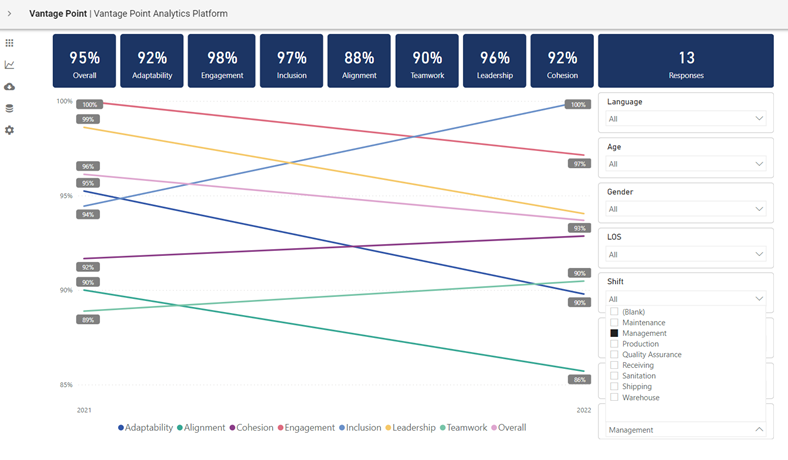
  1. Can you compare results across surveys? Some surveys allow you to see the trends from multiple surveys. And allow you to drill into those results from the top screen (per #1, above). The example shows the trend for 13 managers of a 200-person organization across 2 surveys. This chart invites a leader to ask, “What caused the changes?”
  1. Has the survey been tested for reliability and validity? One survey, Vantage Point, scored .92, .92, and .93 for reliability using Cronbach’s Alpha Test on its 3 scales: adaptability, engagement, and cohesion. (The threshold to be considered “reliable” is .70.) And Vantage Point achieved a very high score of .90 on validity using Confirmatory Factor Analysis.
  2. Are the results actionable? The questions themselves need to be specific enough to be actionable, otherwise the survey is just data – nice to know, but not helpful in terms of suggesting what to change.
  3. After-survey support. Does the survey consulting organization offer expert after-survey support? Is that support fairly priced? Is that support readily available?

Gary Langenwalter

#19 Flying Blind

While I was driving on the interstate, my all-digital dash went totally black. No speedometer, no gas gauge, no temperature gauge. Nothing!

Managing without an employee survey is like that – you really have no idea what your people are thinking. Where the hot spots are. Where the good spots are. Some things are obvious – one department is doing well, but you can feel the tension as you walk into another department. But some things are not so obvious – for example, differences of opinion by gender or age or length of service. Because of that, an employee survey is a “must have” for attracting and retaining the best and brightest.

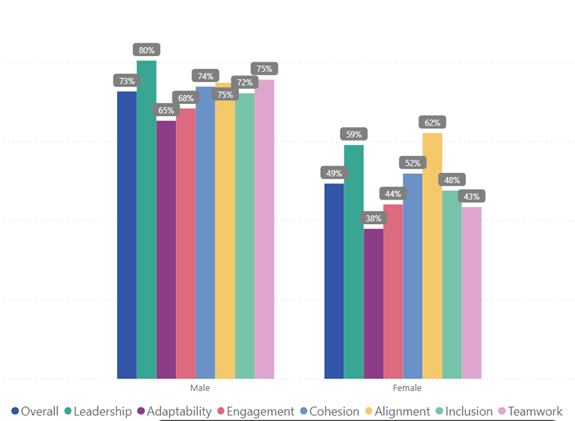
At one of my clients, female millennials scored MUCH lower than male millennials in 7 critical dimensions, as shown in the chart: leadership, adaptability, engagement, cohesion, alignment, inclusion, and teamwork; the composite score was 24 percent lower. The CEO and leadership were not aware of this difference until the company took a survey, because their female millennials were spread throughout the organization. Once the leaders saw these results, they were able to take corrective action before they lost more of their up-and-coming leaders.

One caution: the mere act of taking the survey raises workforce expectations that leadership will do something with the results. If nothing happens, taking the survey will have a negative effect on morale and goodwill. Thus, before such a survey is even considered, leadership should commit to:

  1. Hold individual responses confidential,
  2. Share the survey results with the entire organization, and
  3. Take positive action based on the survey’s results.

This leadership commitment, with concomitant action, will help attract and retain the best and brightest. Why would someone want to leave your organization to go to a place that doesn’t care about them? And once the workforce realizes that they are being listened to, they can’t help but tell others about what a great place they’re working.

There are many organizational health surveys available. I’ll give you some hints about how to select one in next week’s blog.

Full disclosure – I’m one of the authors of Vantage Point organizational health assessment, which was developed and honed by 25 organizational development professionals in the Organization Development Network Oregon. You can see how it works on www.vantagepointsurvey.com

Gary Langenwalter