Motivation

Stopping our Negative Self-Talk

I’ve been struggling the last couple of weeks with negative chatter in my head. I’ve always been a bit perfectionistic and have set-up quite the high bar which makes it fairly easy to not make the mark. When I receive constructive feedback, even though I desire it, it hits me very emotionally. Then I started trying to figure out where that came from.

My fear of abandonment at a very early age caused me to try to fit in at all costs. Be the funniest, the smartest, most accommodating & collaborative. At the same time I was always seeking external approval. What a setup! Trying to please all those people, all the time. Very exhausting. So, my value relied not on my own self-worth, but how others’ saw me. But now at least I’m more aware and working on myself. But it is a long-term journey.

So, what are some of the causes of this negative self-talk chatter? Four ways emotions are created:

1. Chemicals we consume directly affect our brain.

2. Hormones in the body – 30+ hormones that support the brain function.

3. Damages to the brain – due to an accident or impact.

4. Self-talk and pictures we make up in our brain – our internal dial.

Another interesting fact:

1. 65% to 75% of all emotions are created because of the self-talk and the mental images we create inside our minds.

How does this apply to businesses? Why as manager should I be concerned with my employees negative self-talk? Because you as the primary motivator and leader can directly impact some of this. Think about it. Employees, as any normal human being, desire feedback on how they’re doing? Could they do their jobs any better? And you as their manager, provide them with constructive feedback & hopefully, some effective coaching. Often because there’s not enough time in the day…and we don’t take adequate time to think about what we want to convey to our employees. But even taking 5 minutes before you have some feedback for someone will help you get a little clearer.

And most likely, you have your own issues with negative self-talk. So, what better way to address this issue by working on yourself first. So, following are some suggestions to begin the process:

1. Begin by watching and paying attention to you internal dialogue and negative and positive dial.

2. Become aware of your “negative” thinking pattern or patterns.

3. When you start thinking negative thoughts check in with yourself and try to understand why you are thinking this way – take time to be in the moment of what is happening around you that is triggering this negative self-talk or chatter.

4. Take steps to clear the chatter – talk to someone, write it down in a personal journal, stop what you are doing at that moment and start something new, fresh, positive, etc.

Good luck with staying on the positive path!

Greg Sievers

A True Partner

Most organizations pride themselves on how they help their customers. A select few go far beyond the rest. Umpqua Bank is a leader in those organizations that go far beyond the norm.

So how does Umpqua set itself apart? They focus on building community. Other banks say that; Umpqua does it in many unique ways that are valuable to its customers. Here are 5:

· They staff to have no lines. That means that in non-busy times, “tellers” are waiting customers. Actually, that’s almost always the case – no waiting at all. I’ve had accounts at other banks where lines were the norm.

· Want to take out a loan to buy a car? In other banks, you’d need to see a loan officer. And if that person is busy with another customer, you’ll be waiting a while. Umpqua cross-trains ALL its customer-facing employees. They’re not “tellers” – they’re “Universal Associates.” The difference? Each of them is trained to help you get that car loan – they’ll leave their station and take you into an adjacent meeting room to complete the paperwork in privacy. An Umpqua Universal Associate has the training and skills to be an assistant branch manager for any other bank.

· Umpqua is a place to relax a bit. Each “store” (they’re not “bank branches”) has PCs and a printer available for the public to use. They have easy chairs to sit in, and a selection of current magazines and papers, both financial and non-financial. Much more than just the typical cup of coffee. (Oh, and they have their own roasted coffee beans for customers as well.)

· They give back to the community – in spades! Each employee is encouraged to spend 40 hours/year on community service, such as helping at the local food bank, animal shelter, etc. – on company time, for pay! So when you walk into an Umpqua store, instead of the typical nameplate, you might see a hand-lettered sign saying where that associate volunteers. So far, they have donated more than 250,000 volunteer hours! At 2000 hours/year, that’s 125 volunteer years!

· Finally, some “stores” have meeting rooms available for use by the public, free. For a small business or non-profit, those meeting rooms are much better than the local Starbucks. They are closed, quiet, and private. (And Umpqua even provides free coffee!)

Using Umpqua as an inspiration, can you extrapolate how your organization could go the extra mile for your customers?

Gary Langenwalter

Dance Like No One’s Watching!

For much of my life I’ve been a hard worker, focused on being the bread winner for my family, attempting to align my skills & competencies with the role & the organization. But much of that time I was complying with the organizational needs of who I they wanted me to be…but not who “I” really wanted to be! Welcome to gerbil wheel….the corporate henchman stated. This will be your destiny until death do us part. Reluctantly, climbing onto the wheel I complied. Running, running, running. Getting tired. Sleeping & getting up to do it again & again. Earning the almighty paycheck. Consistently providing for my family. But at what cost? Almost sucking my SOUL dry. Of not honoring all my gifts & talent. But every once in a while….I got off that damn gerbil wheel…did what my heart desired!

I danced like no one was watching. I sat in drumming circles. I became a Corporate Shaman…that’s pretty woo-woo isn’t it? But who cares. I had deep spiritual dialogue with people….contemplating the meaning of life. I had to stop pleasing others and please MYSELF! I acted like a silly, uninhibited 3 year old child. I was goofy. I played. I laughed, I cried. I discovered others’ like me who were truly authentic. Who shared their true selves with me and I with them. I found that freedom simply delightful. I found myself. Ahhhhhhh…..now I can relax.

Now, that I’m of retirement age and practicing retirement, I am just beginning to embrace those child-like tendencies once again. I have climbed off of that gerbil wheel. Aligning with what gives me happiness & joy! I am getting to do more training & development which was always my passion. Facilitation. Coaching. All helping people be happier and more successful! That’s my purpose on this planet. I’m choosing the projects I now work on….with no more forced compliance….and corporate obligation. It’s my choice. I think I’ll say that again….it is MY choice! I am now aligning with my passion and competencies, my gifts and talents. I’m now in the FLOW…where I am attracting opportunities. They’re magically coming to me and I’m not desperately seeking them out. The more I do so…the more the opportunities come out of the woodwork. I’m really starting to like this new paradigm!

Dancing Like No One’s Watching,

Greg

Getting Buy-In

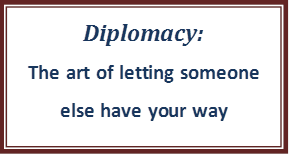
My favorite definition of diplomacy: “the art of letting someone else have your way.” For most of us, that’s a necessary skill in our work and in our personal lives. The real art, however, is in having someone else WANT TO do something – that’s buy-in.

Telling the boss what to do qualifies as a CLM (Career Limiting Move). Ditto for our peers – they can derail our careers if they choose. And although it’s easy to tell the people who report to us what to do, getting their buy-in will improve their performance (and thereby help our careers as well).

The art of achieving buy-in rests in asking the question from the other person’s viewpoint – What’s In It For Me? Why should they want to do what I want them to? Answering that question requires me to put myself in their shoes, to understand what they want, and then to be willing to use my resources to help them achieve their goals.

Buy-in can work with almost anybody, anywhere, and any time. With subordinates, peers, and bosses. It works best, however, when the other party is also interested in creating a win/win.

Buy-in is invitational. It deepens relationship, fosters a spirit of co-creating, demonstrates power sharing. It directly contrasts to the typical power-over, command-and-control behavior that permeates so many of our organizations. It is one small, but powerful, step toward a healthier organization.

Gary Langenwalter

Work for Free?

If you stopped paying your employees, how many would continue to work for you?

Yes, I know that they appreciate being paid, and most do not have the luxury of working for no pay. But let’s ignore that for a moment, and ask the question again: If you were not able to pay your employees, what would you do in order to attract and retain volunteers to keep your organization going?

Peter Drucker has said that not-for-profit organizations are the leading edge of leadership, because leaders in those organizations have to lead people much more effectively, since a large part of their workforce is volunteer. Volunteers work for an organization because they are attracted to the vision and mission and purpose, and because they are treated with respect.

To be truly revolutionary, you could ask your employees why they work for you. Hint: most people do not work primarily for the money. Most people could find another job making roughly the same income. Why do they stay with you?

And then ask them what they would like to see changed to make their work experience more meaningful.

However, be aware that the mere act of asking these questions raises expectations on the part of the employees, so before you ask them, you’ll need to be committed to do something with their answers.

GloryBee, in Eugene, has a formal process of asking each employee a series of questions like this (outside of the performance review). The dialogue between employee and supervisor has 9 questions, each of which is answered by the employee and the supervisor. The first question is, “What made you choose GloryBee as your employer?” The form is posted in the Ideas section of our website. http://wp.me/P4ohNu-7t3

If you stopped paying your employees, how many would continue to work for you?

Gary Langenwalter