Author: gary

8 – From Programmer to VP Sales and Marketing

One more way to retain and attract people: a “grow your own” process. You ask each employee what they’d like to be doing 5 or 10 years in the future, then actively support them as take the risk of trying something new. You can help them get the education and skills and training to be able to fill those roles, and assure them that they can revert to their original position if the new one does not work out. Two personal examples:

  1. When I was IT manager at Faultless Caster in Evansville Indiana, I learned that one of our shop foremen was really interested in programming. I brought him into the IT department and gave him the education and training so that he could blossom.
  1. At Burroughs Corporation (now Unisys), one of my programmers was a natural schmoozer. He was a good programmer, but he talked with people whenever he had the opportunity. And he made LOTS of opportunities! So we transferred him to the sales and marketing department. He rose through the ranks, eventually becoming the VP Sales and Marketing of a large computer manufacturer.

In each case, we helped the employee develop their innate talents and grow far beyond where they would have if they had remained in their initial career path. Both they and the company benefited greatly.

A second way to grow your own is self-managed work teams. One of their major benefits is that they naturally incubate leaders. When I help a client create self-managed work teams, I have each team rotate positions of team leader and scribe every month until everyone has filled both positions. Then I let the team decide whom they would like as their leader. That person is a candidate for future promotion. Promoting from within has a major impact on employee loyalty and retention; it is especially attractive to the best and brightest.

But what about people who want to remain where they are? Perhaps they’d be interested in being the mentor or trainer for new hires. Or doing something else to widen and enrich their position. Even those people who want to remain right where they are with no changes whatsoever will appreciate that you respected them enough to have the dialogue with them.

What does it cost? All it takes is an open mind and willingness to listen to an employee and help them see what might be possible, then support them as they take steps toward their dream. If that attitude permeates your organization, why would anyone want to leave? And why would a candidate that you’re recruiting choose any other organization instead of yours?

Have you seen this work in your organization?

This is the 8th blog in the series, “How to retain and attract employees”.

Gary

Gary Langenwalter

Portland Consulting Group

Wisdom for Exceptional Results

971-221-8155

www.portlandconsultinggroup.com

#7 Profit Sharing – Employee Retention and Attraction

Why share profits with your employees? 2 reasons:

  1. It helps with retention and attraction, and
  2. It boosts productivity.

Given a choice between working for an organization that shares its profits and one that does not, most people will choose the one that rewards their efforts. “Study after study shows that workers belonging to ESOPs and group-based pay schemes tend to identify more strongly with the firm than those on standard fixed-pay contracts,”* states Harvard Business Review, based on a huge program of research by the National Bureau of Economic Research and similar studies in the UK and elsewhere.

Organizations used to use piece rates to reward production. But with the advent of team-based production systems, plus types of work that don’t lend themselves to piece rate mentality, organizations have moved to rewarding the workforce for net gains in profits. HBR says, “such plans can and do work…when combined with supportive management practices. This research found that three of the most prevailing concerns about the efficacy of team incentives were more myth than reality.”* For example, workers in profit-sharing organizations apply social pressure to slackers in their work group so that they do their fair share or leave the company. And workers in profit-sharing organizations tend to work harder. This concept applies equally well to non-profits – they can share their surplus with their workforce.

When I was creating a class on Lean for the workforce of a heavy manufacturer, I met with a group of owners – who were from all levels and areas of the company. A production worker in that group asked the kind of insightful questions that I would normally have expected from an owner, not a production worker. He was thinking like an owner because he was, indeed, an owner, even though his job was on the factory floor. How much more productive and effective would your workforce be if they thought and acted like owners, all the time? And what would that do to your bottom line?

Gary

Harvard Business Review, reprint 161213, December 13, 2016

Employee Retention 6 – Financial Literacy

How many of your employees understand the basics of personal finance? How many know what a household budget is and how to use it? How many know the benefits of saving for retirement, especially the benefits of starting at an early age?

As one way to attract and retain employees, you could offer financial literacy courses to your employees and their immediate family members. Topics could include:

  • managing credit cards,
  • how to finance a car or apply for a loan,
  • what a credit score is and how it affects the interest rate on their loans (and how it can be improved),
  • how to create a basic personal budget,
  • how and why to save for retirement, including the huge benefits of starting early,
  • how to reconcile a checking account (even if they use their debit card for all their transactions),
  • and others.

How would this work? You can furnish the space, the munchies, and the instructor at minimal cost.

  • The instructor: A local banker or financial planner would probably be delighted to teach the course at no cost to you. They could provide a certificate of completion. They would be compensated in two ways: 1) helping the community, and 2) gaining potential customers.
  • Space: if you don’t have an appropriate room, a local church, motel, senior center, or other organization like a Chamber of Commerce or a bank would probably be willing to provide space at no cost or very low cost since you’re doing this as a public service.
  • Munchies: people learn better on full stomachs, and munchies help build camaraderie. Participants would really appreciate light finger foods and non-alcoholic beverages.
  • Incentives: You might even create a relationship with a local financial institution (e.g. local bank, savings & loan or credit union) to offer an incentive for your employees to bank there.
  • Payroll cost: the course would be offered after hours, so no payroll cost.
  • Expectations: participation would be completely voluntary.

The result: your employees become more loyal. Not only those employees taking the course, but other employees who appreciate how you’re helping your people have better lives. And they tell their friends how well they’re being treated at your organization. So their willingness to move to another organization goes down at least one more notch, especially if their family members have also participated in this course, and your reputation in the community as the best place to work goes up a notch or two. Isn’t that worth organizing the class and buying a little food?

If this proves popular, you might consider asking your employees what other life skills they would like to learn more about.

What do you think?

Thank you for reading,

Gary

#5 Employee Retention Triple Bottom Line

What’s the bottom line for your organization? One powerful way to attract and retain the best and brightest is to replace your “bottom line” with the Triple Bottom Line (People, Planet, Profit/Performance), which is one definition of true Sustainability. Why does this work?

The unwritten social contract of a typical organization is this: employees work for what the bosses value, which is usually money for the owners, in exchange for a paycheck. Employees are expected to be loyal to the organization and help it succeed, even at some cost to themselves and what they value, for example, missing a child’s soccer game because of required overtime.

What if an organization asked employees what they valued, then asked them to help the organization’s products and services reflect and support those values? I’ve consulted in countless organizations on four continents. The one constant I have seen, no matter the country or the level in an organization (janitor to CEO), is pictures of family. So an organization could ask employees, “Help our organization provide a better life for your family.” You shift your bottom line from “profit/performance” to people, planet, profit/performance, the Triple Bottom Line. Employees become fiercely loyal, because your organization, with their active participation, is making a difference for the people they love.

Cost/benefits? The cost is the increased complexity of decision-making. The benefit is a highly engaged and loyal workforce; you will be attracting and retaining the best and brightest with the same pay scales as before. This will result in improved performance, both financial and non-financial, and your competition won’t be able to copy it.

How can you do this? Use (or create) your weekly continuous improvement teams, but change their focus from improving quality and cutting waste to using your products and services to improve the quality of life of their loved ones. If you’d like more information on continuous improvement teams, please feel free to contact me. No cost, no obligation, of course.

Want to learn more? I not-so-humbly recommend a business novel, The Squeeze – a novel approach to business sustainability. (I’m the author.) It is indeed a novel with dialogue and a road trip. It also has footnotes to support the facts that its characters discover. When I was about halfway through writing it, it took on a life of its own: the characters started creating their own dialogue and changed the plot. If you’d like an autographed copy, let me know.

Gary

#4 Stay Interviews

Why do your employees stay? There’s only one way to find out – ask them. Each stay interview can last about ½ hour. This blog is excerpted from The Power of Stay Interviews for Engagement and Retention, Second Edition by Richard Finnegan, as summarized in an article in SHRM magazine (URL below).

To conduct a stay successful stay interview,

  • Listen 80% of the time,
  • Probe to learn more, and
  • Take notes – capturing key points, emotional words and important quotes.

Ask 5 questions, with probing follow-ups to learn what your employee is really thinking and feeling:

  1. What do you look forward to each day when you commute to work? This question focuses an employee on their daily duties and challenges. You can follow up with “give me an example,” or “tell me more about…” or “who do you look forward to working with the most?”
  2. What are you learning here, and what do you want to learn? Follow up questions could include, “Which other jobs here look attractive to you?”, and “What skills do you think are required for those jobs?”, or “What skills would you have to build to attain those jobs or some responsibilities of those jobs?”
  3. Why do you stay here? Take your time, because I really want to know. Potential probing questions are: “Tell me more about why that is so important to you,” “Is that the only reason you stay, or are there others?”, and the converse, “If you narrowed your reasons to stay to just one, what would it be?”
  4. When is the last time you thought about leaving, and what prompted it? This question will probably surprise the employee with its frankness, giving them permission to tell you what they never expected. Potential follow up questions include: “Tell me more about what happened. Who said what?”, and “What’s the single best thing I can do to make that better for you?”, and “How important is that to you now on a 1-10 scale?”
  5. What can I do to make your job better for you? Be prepared to receive potentially uncomfortable but vital feedback which will help you do your job better as well as helping you retain the employee. Some potential follow-ups include: “Do I tell you when you do something well?” “Do I say and do things to help you do your job better?” and “What are three ways I can be a better manager to you?”

Close a stay interview on a strong note: Thank the employee for their time, summarize the feedback you’ve heard, relay what your next steps will be, and provide a clear sense of what the discussion will have changed.

Let me know how this works for you.

Gary

https://www.shrm.org/resourcesandtools/hr-topics/employee-relations/pages/how-to-conduct-stay-interviews-part-2.aspx

Employee Retention and Attraction #3 – Kill the Performance Review

Fear and trepidation – that’s what almost everyone feels as they meet with their boss for their annual performance review. Bosses have it worse! They also have to write performance reviews for each of their direct reports (which they dislike doing), and review performance reviews written by their direct reports.

So why the fear and trepidation? Because we know that we’re going to be criticized, to be told that what we’re doing is not quite good enough. That’s the purpose of a review, isn’t it? Here’s where you’re doing ok, and here’s where you need to improve. It’s a one-way discussion – how we fit into the job description. Nothing about where we can grow personally. We’re just a cog in a machine.

Given that virtually NOBODY likes them, why do we keep doing them? What if there were a better way? How about this – instead of a top-down monologue of judgment “here’s how you measured up to our standards”, create a 2-way conversation. The underlying tone and expectation can be two equal parties working together to help the employee AND the organization thrive. For the first meeting:

  1. Agree jointly on the expectations of performance for the position, and how they will be measured (SMART goals).
  2. Agree jointly on the expectations for growth of the incumbent, both professional and personal, where applicable (for example, communications skills). Ask the incumbent where they would like to grow and how the organization can help.
  3. Agree on the resources and support that the organization will provide to help the incumbent succeed.
  4. Agree on communication style and frequency. For example:
    1. Weekly verbal check-ins.
    2. Texts and/or e-mails frequently and as appropriate.

i. Attaboys or attagirls when something has been done well

ii. Help with overcoming obstacles. Instead of “you missed the mark (implicitly blaming the incumbent), assume that the incumbent did the best they could with what they had available. Ask “What happened? How can we work together to get the desired result? What does the organization need to do so that you can succeed?” This is a classic TQM/Lean approach.

    1. Monthly scorecard review of the agreed-upon SMART goals:

i. Holding the incumbent accountable for performance, and asking what could change to help the performance improve.

ii. Holding the organization accountable for resources and support, and modifying the goals to reflect availability of resources and support.

iii. Agree on adjustments to the goals, based on what you now know.

For subsequent meetings, jointly assess how well each party has achieved its goals – that includes how well the organization has supported the employee (steps 3 and 4). Instead of the “you failed” attitude when a goal was not met, try “What happened? What can we learn from that? If we still want to hit the goal, how can we do that?”

This will help your best and brightest want to remain with you, because they will feel valued and respected. Morale increases, at no additional expense. What’s not to like?

Gary

Retain Your Employees #2 – ESL

One way to retain employees is to help them grow. That establishes a VERY strong bond between employee and employer. ESL (English as a Second Language) courses help people whose English is limited grow both professionally and personally. The Conference Board found improved English proficiency correlates with increased employee engagement and retention.*

All you would need to do is to provide the space (e.g. the cafeteria or a conference room), the materials (readily available), and the instructor. Here’s some random ideas on how to get started:

  • Contact the local high school or community college to learn what they have available and a list of potential instructors.
  • Inquire about federal, state, county, or local grants to defray your cost.
  • Contact your local Chamber of Commerce – they might know of other employers who would like to add employees to the class (and who would share the cost).
  • Don’t have a good space at your facility? A local hotel or retirement center might be willing to provide space at no charge as long as they could put a couple employees in the class. Or a local church might offer space at no cost or low cost as a ministry to the community.
  • As a gesture of hospitality, provide modest munchies. People learn better when they’re not hungry, and sharing food builds connections. A local grocery store or restaurant might be willing to provide the food at their cost or no cost to help support the program.

If you so choose, you could also make these courses available to employees’ family members, again strengthening your employees’ loyalty.

Don’t have any non-English speakers? Perhaps ESL courses would entice them to join you.

One final thought: offering such a program helps your image with your other employees and your greater community as well. When you compare the cost of such a program to the improvement in employee retention and attraction, this should have a VERY high financial ROI. Win-win all around.

Let me know how this works for you.

Gary

*English Classes Help Retain Immigrant Workers, February 20, 2021, https://www.shrm.org/hr-today/news/all-things-work/pages/english-classes-help-retain-immigrant-workers.aspx

Work-Work Balance

Four days before my August wedding, my boss told me, “Gary, we can let you have the weekend off for your wedding, but you need to be back here Monday morning. We’re behind schedule.” [I had scheduled the two-week vacation several months earlier.] I replied, “I’m only going to get married once in my life, and my wife starts teaching school in three weeks. We can’t delay our honeymoon. I’ll see you when I get back.” My boss replied, “I’ll remember this on your performance review.” And she did. I got an F- on attitude, and the very large consulting company pushed me out the door, saying I was not professional and not fit to be a consultant. “Professional” to them meant that they owned my time 24 hours/day, 7 days/week. I learned later that this was standard operating procedure for this firm – work the consultants until they drop. And the 10% who put up with it became partners, perpetuating the culture. (I am still married to the same wonderful woman.)

In the 1970s when I was traveling the country helping clients implement manufacturing software, the most common refrain I heard from their professionals, middle-aged and older, was “I wish I had spent more time with my children.”

Fast forward a few decades. One of my relatives was working for a multi-national high-tech company. His boss was an Indian ex-pat who had no family here and no interests outside of work, so he worked 14-16 hours/day AND expected all his subordinates to do the same. So my relative would frequently be on the phone at 2 a.m. to India, or Germany, or wherever in the world someone he needed to talk to him. He left the company.

By contrast, the Oregonian publishes a list of the Best 100 Companies to Work For annually. These companies have people lining up to work for them. Many don’t even have to advertise their open positions. One example is Cascade Corporation in Fairview. When they have an opening, they ask their workforce whom they know that would be a good fit.

PS – many years ago, the department that dealt with people was called Personnel. The name got changed to Human Resources. I strenuously object to that term – people are not “resources” to be moved around a chess board, or used like financial or physical assets and discarded when they are used up. They are, or at least can be, partners in creating great products and services. To view them as “resources” dehumanizes them and implies that their only value is how they can benefit the company.

The choice is yours. You CAN keep and attract the best and brightest. All you have to do is treat them as if they matter, as fellow human beings in this adventure called life.

I welcome your feedback

Gary Langenwalter

Increasing Employee Retention and Attraction

How do you attract the best and brightest and retain them? That’s the common refrain among virtually ALL leaders, in all sectors – for-profit, not-for-profit, government… everywhere! Here’s a list of ideas, in no particular priority or order. I’ll be blogging Monday afternoons each week on at least one of them starting April 4. Let me know additional topics that you’d like to see included.

  1. Listen to your employees
    1. Take a survey
    2. “Stay” interviews
    3. Focus groups
  1. Engage your employees
    1. Triple Bottom Line

i. Include employee values/goals/dreams into your organization vision, mission, and products and services

    1. Be transparent

i. Open your books

    1. Continuous Improvement Teams
    2. Company sponsored social events
    3. Profit sharing
  1. Invest in your employees – help them grow
    1. Professional training
    2. On the job coaching
    3. Life skills for employees and their families

i. Parenting

ii. Financial acumen

        1. Budgets
        2. Credit cards and debt

iii. Relationship improvement

iv. ESL

  1. Be flexible with your expectations
    1. Flexible hours
    2. Remote work arrangements
  1. Respect your employees
    1. Predictable schedules
    2. Fair pay

i. Vs. market

ii. Owners / employee ratio of pay

    1. Parent vs. Partner
    2. Job – role vs. coronation
    3. Kill the performance review
    4. DEI

Leadership That Works!

Our culture has it all wrong! We imagine the best leaders to be authoritative, with the leader being in front. Being bold and decisive and fearless. Being the person that the employees defer to. After all, that person is the boss, so their decisions must be right. And since this style of leadership is in our cultural DNA, it must be the best, right?

WRONG!

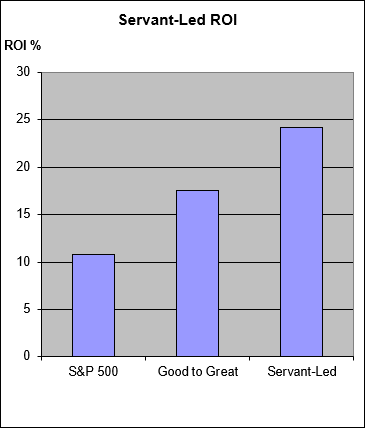
Let’s look at actual data. Sipe and Frick compared the results of three types of leadership over a ten-year period: “traditional” (using the S&P 500), “Good to Great” from Jim Collins’ book with the same title, and servant leadership. Here are the results.

The actual numbers are:

  • Traditional – 10.8%
  • Good to Great – 17.5%
  • Servant – 24.2% – MORE THAN DOUBLE traditional leadership!

According to Sipe and Frick, a servant leader:

  • Has character
  • Puts people first
  • Is a skilled communicator
  • Is a compassionate collaborator
  • Has foresight
  • Is a systems thinker, and
  • Leads with moral authority.

I attended a celebration welcoming a new business, Home Instead, to our community last fall. At the end of the event, the CEO, Todd Barth, worked unobtrusively alongside his employees in cleaning tables, putting chairs away, etc. The unglamorous, unappreciated, behind the scenes work. His actions exemplified servant leadership.

Want you and your employees to enjoy work more? Want to attract and retain the best and brightest? Try servant leadership – it costs nothing except for a changed mindset.

I hope that you and yours stay well and have a wonderful year,

Gary